
Bridging the Knowledge Gap: Reflections from the Youth Energy Summit 2025
Earlier this year, Kai Forster, Consultant at the Transforming Energy Access – Learning Partnership (TEA-LP), led a high-energy panel discussion at the Youth Energy Summit (YES) 2025 in Cape Town. The session, titled “Bridging the Knowledge Gap: Collaboration Between Industry and Academia,” brought together a dynamic group of experts to explore how stronger partnerships can prepare Africa’s next generation of clean-energy professionals for the future.
Connecting Education and Industry
In moderating the session, Forster opened with a challenge: how can Africa’s academic institutions keep pace with the rapidly evolving needs of the energy sector?
Across the continent, universities continue to produce technically capable and gifted graduates, but many young professionals still struggle to transition effectively into the workforce. While the technical foundation is often strong, there remains a gap in practical experience, interdisciplinary thinking, and soft-skill development, all of which are critical in a sector that increasingly values adaptability, communication, and collaboration.
“At TEA-LP, we’ve seen first-hand that knowledge alone is not enough,” said Forster. “Real transformation happens when academic learning is connected to industry practice, when graduates are empowered with both technical understanding and the human skills to apply it meaningfully.”
Insights from the Panel
The discussion brought together leaders from both the public and private sectors, including Aatifah Latief (City of Cape Town), Sherrie Donaldson (Harambee), Mapaseka Setlhodi (Presidential Youth Employment Intervention), Tsholo Mogotsi (Youth Employment Service South Africa), and Atiku Jafar (Bowyard Partners).
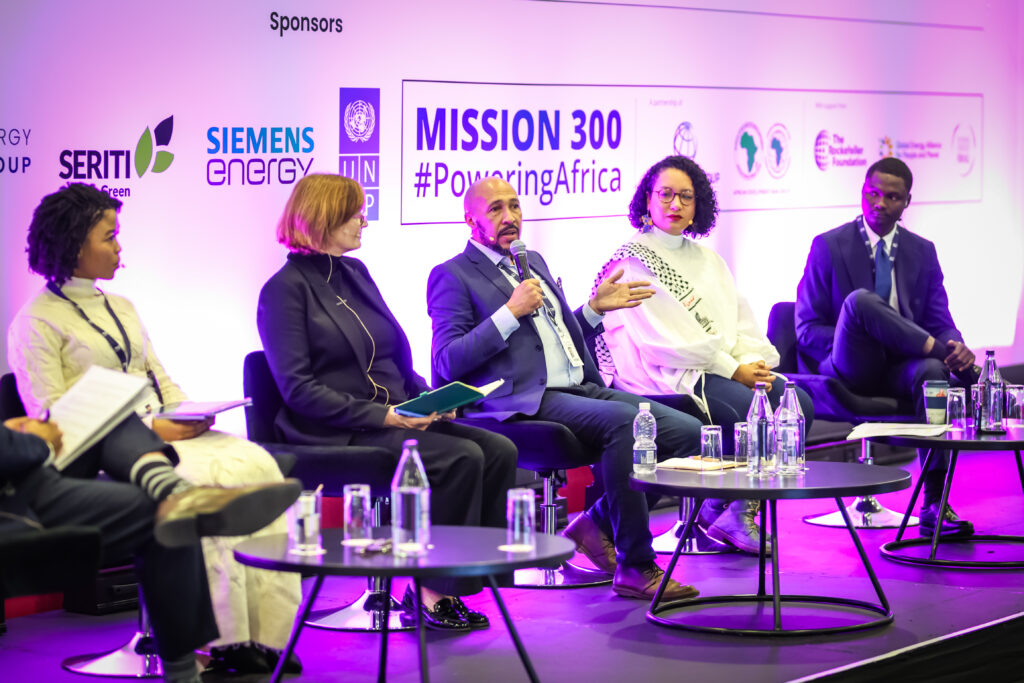
The panellists, from left: Mapaseka Setlhodi, Sherrie Donaldson, Tsholo Mogotsi, Aatifah Latief, Atiku Jafar
Together, the panellists explored the roots of the academia-industry divide and offered ideas on how education systems could evolve going forwards to meet Africa’s growing energy needs.
Tsholo Mogotsi highlighted the importance of multidisciplinary skill sets:
“It takes more than just people to install a solar panel. We need knowledge of the energy mix more broadly: regulatory, legal, financial, and human dimensions.”
Sherrie Donaldson reframed the youth employment narrative:
“Young people aren’t the problem, they’re just not being prepared effectively to grab opportunities with both hands.”
And Mapaseka Setlhodi emphasised the shifting priorities of young professionals:
“If we change jobs after 18 months, that’s not apathy; it’s hustling. What keeps young people in a position is being challenged, valued, and heard.”
How TEA-LP is Responding
Many of the challenges raised in the discussion lie at the heart of TEA-LP’s mission. Since its inception, TEA-LP has worked closely with universities across the African continent, South Asia, and the Pacific Islands to support in the development of Masters’-level curricula, as well as design and deliver accredited Continued Professional Development (CPD) programmes that integrate practical learning, industry engagement, and systems thinking.
These programmes are intentionally designed to:
-
Equip graduates with hands-on tools and applied skills for real-world energy challenges.
-
Promote collaboration between academia, private sector, and government to ensure training aligns with evolving industry needs.
-
Build inclusive networks and communities of practice that empower academics and professionals to share knowledge, resources, and opportunities.
-
Support faculty development and curriculum design, ensuring universities remain responsive to industry shifts.
“Our goal is not only to strengthen the talent pipeline for Africa’s energy transition, but to ensure that this pipeline is inclusive, relevant, and ready to deliver impact from day one.”
Building the Bridge
The panel closed with a shared recognition that bridging the gap between academia and industry requires extensive communication and co-creation, and that the solutions are already within reach when stakeholders work together.
-
Academia must embed practical and problem-based learning into curricula.
-
Industry must invest in mentorship and structured work-integrated learning opportunities.
-
Policy-makers and funders must enable partnerships that reward innovation and collaboration.
-
Young professionals must continue to approach their careers with curiosity, adaptability, and purpose
The gap between academia and industry isn’t a wall, it’s a bridge waiting to be built, and we all have a role to play in building it.
You can read YES!’s summary of the event here.
Written by Kai Forster
