
Advancing battery technology for a cleaner energy industry in Kenya
A stakeholder validation workshop on battery technology was held at Strathmore University, Nairobi, on 9 October 2025, organised by the School of Computing and Engineering Sciences (SCES) with support from the TEA-LP Rolling Fund.
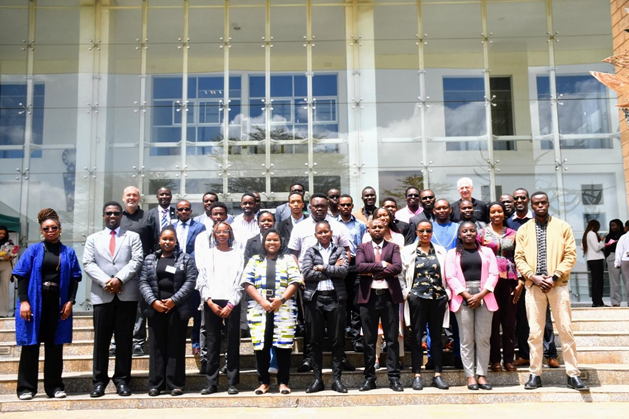
Workshop participants outside Strathmore University following the opening session. Source: Strathmore University, 9 October 2025.
The workshop brought together over 60 participants from industry, academia, and regulatory bodies including Kenya Bureau of Standards and Energy and Petroleum Regulatory Authority, alongside development partners. The aim was to validate ongoing battery research, review the regulatory environment, and identify practical steps for advancing battery technology in Kenya’s energy and e-mobility sectors.
The conversation was urgent and practical: how does Kenya build a battery ecosystem that is safe, affordable, and ready to power the country’s growing renewable energy and electric mobility ambitions?
Session Highlights:
The workshop was officially opened by Eng. Dr. Julius Butime, who emphasised the necessity of collaborative platforms to ensure deployed battery technologies are safe, affordable, and aligned with sustainability goals.
Throughout the day, technical sessions delved into the multifaceted battery ecosystem:
● Safety, Standards, and the Regulatory Landscape
A central theme of the day was the gap between Kenya’s current regulatory framework and the pace of battery technology deployment. Francis Romano of Knights and Apps led discussions on battery chemistries and design, while Winfred Kimuya from the Kenya Bureau of Standards (KEBS) emphasised the critical role of Battery Management Systems (BMS) in ensuring safety and performance. Compliance with international standards, such as IEC 62619 for functional safety, was a major focal point.
● Batteries as the Backbone of Energy Access
Jon Exel from the World Bank – ESMAP anchored a session on how battery technology is vital for Distributed Renewable Energy (DRE) access, highlighting the “Mission 300” initiative which targets electricity access for 300 million Africans by 2030. Jon made it clear that none of it is achievable without reliable, affordable energy storage. For Kenya’s mini-grids and off-grid communities, batteries are not a peripheral component – they are the infrastructure.
● From Waste to Value: The Circular Economy Opportunity
Shaun Mumford of Enviroserve Kenya brought a timely perspective on what happens when batteries reach the end of their first life. Kenya currently lacks the formal value chains needed to safely repurpose or recycle used batteries at scale – a gap that represents both an environmental risk and an untapped economic opportunity. As one participant noted during the session, safe repurposing cannot happen without standardised testing protocols and clear policy support. Getting that framework right is now a shared priority.

Panelists exploring the realities of localising battery manufacturing and workforce development in Kenya. (from left): Shaun Mumford, Eng. Dr. Julius Butime, Francis Romano. Source: Strathmore University, 9 October 2025.
Reflections and Challenges
The plenary discussion, moderated by Dr. Victor Rop, surfaced key challenges alongside the opportunities. Participants actively engaged with the realities of the local market, validating the assumption that batteries are the central enabler for Kenya’s renewable energy and electric mobility agendas.
Participants pointed to two main gaps: the lack of accredited battery testing and certification infrastructure in Kenya, and a widespread skills shortage in battery diagnostics, material recovery, and repurposing. These were consistently raised across sessions as the most immediate barriers the sector needs to address.
Key Outcomes
Three commitments were agreed upon by participants:
● Formation of a Kenya Battery Working Group to coordinate policy dialogue and capacity building
● Development of accredited battery testing and certification laboratories in the country
● Launch of targeted skills development programs bridging universities, industry, and regulators

Participants during one of the workshop sessions. Source: Strathmore University, 9 October 2025.
Why This Matters
This workshop represents a direct contribution to SDG 7 – Affordable and Clean Energy. Discussions on mini-grid reliability, productive-use applications, and grid resilience reinforced the central role of energy storage in expanding energy access.
The TEA-LP Rolling Fund made this possible by bringing together regulators, private sector leaders, and academics to translate research into practical, cross-sectoral strategy. The next step is turning the commitments made here into policy and infrastructure.
– Written by Neema Oribo and Serena Cheres
The TEA-LP is supported by UKAID under the Transforming Energy Access Platform.

