
Driving Sustainable Energy Transitions: Inside TEA-LP’s New CESET Course
The Transforming Energy Access – Learning Partnership (TEA-LP) is excited to share that the first cohort of our newest Continued Professional Development (CPD) course, the Circular Economy and Sustainability in the Energy Transition (CESET), has launched, and that they are well on their way towards obtaining their CPD points. Developed in collaboration with some of the continents’ leading experts, the course promises to provide successful graduates with a range of knowledge, skills, and competencies that can equip them to contribute towards the clean energy transition, with circularity and sustainability at the forefront.
The CESET course empowers professionals to address the complex intersection of renewable energy, sustainability, and circular economy practices, integrating technical, policy, business, and social dimensions of the clean energy transition. There is a strong focus on applied learning and relevance to the Global South, with the course being taught in the context of developing regions around Africa, South Asia, and the Pacific Islands.
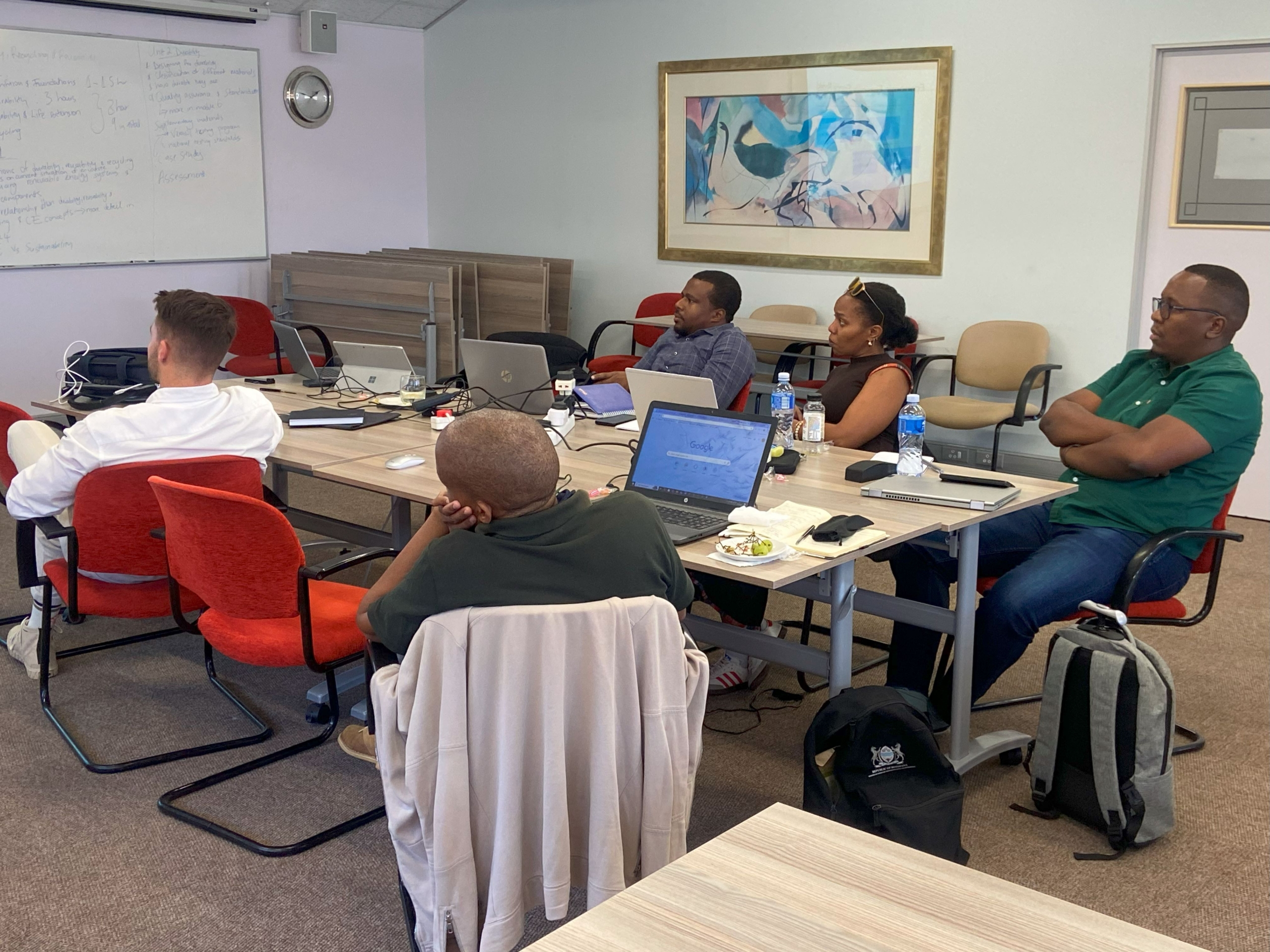
The CESET team working on the course at the development workshop at the University of Cape Town.
Bringing together the best
CESET is structured into six modules covering the full spectrum of sustainability in the energy transition. Each module was developed by a different content expert, who have shown a demonstrated history and track record as a leading authority in their respective fields of expertise within the energy sector. Module 1, developed by Mrs. Nancy Mwari Murithi of Kenya, introduces the foundations of environmental and social sustainability, while Module 2, by Mr. Tumisang Ruda of Botswana, examines the policy and regulatory frameworks that shape renewable energy deployment, offering insights into how policy and regulations can be adapted to support the clean energy transition through circularity and embedded sustainability. Module 3, developed by Mr. Yame Nkgowe of Botswana, delves into circular economy principles and concepts, and is followed by Module 4, which provides practical strategies for durability, reusability, and recycling of technologies – delivered by Ms. Kinya Kimathi of Kenya, founder of well-known and respected recycling company in the region, Kijani Testing Ltd. Speaking to her experience of contributing to the development of CESET why it is beneficial in the current landscape, Kinya Kimathi had the following to say about her contributions to the course:
“Contributing to this course has been an exciting opportunity to share practical insights on the circular economy in renewable energy. Often, we think of sustainability as something that can be achieved by large organizations or by making large changes, but in reality, we all contribute, even in the smallest ways. Think about how you dispose of a dead battery or a broken phone: these small choices matter.”
Module 5, by Mr. Femi Adeniyi of Nigeria, addresses renewable energy supply chains and sustainable resource use, using the context of solar PV systems, which are currently widely regarded as the most viable solutions for widespread advances in energy access. Femi had the following to say about the course:
“Helping to develop the CESET course has been incredibly rewarding, allowing me to translate years of field experience into practical frameworks, reinforcing my belief that the energy transition in developing regions requires more than just technology deployment—it demands a fundamental reimagining of how we design resilient, circular supply chains that create lasting local value.”
Finally, Module 6, by Dr. Jeffrey Baiden of Ghana, equips learners with tools in finance and business modelling to design resilient, bankable solutions. Together, the modules provide a comprehensive skill set to support just and sustainable energy transitions.

The team behind the development of the CESET course enjoying the views from Rhodes Memorial after the course development workshop. From left: Kai Forster, Tumisang Ruda, Yame Nkgowe, Kinya Kimathi, Mascha Moorlach, Femi Adeniyi, Jeffrey Baiden. Absent: Nancy Mwari Murithi.
Global South relevance
The content experts all hail from across the Global South, ensuring that the course reflects regional priorities, challenges, and realities. While grounded in global sustainability frameworks, the content is adapted to African contexts and similar settings, making it directly relevant to practitioners working in energy access and low-carbon transitions. By combining technical, policy, and socio-economic perspectives, CESET bridges academic knowledge with practical challenges in the field – identifying best practices and opportunities with unique insights from the experts’ firsthand experience.
The course addresses several pressing needs in today’s energy landscape by advancing the shift toward sustainable and circular approaches to energy technologies, while also responding to the growing demand for professionals who can integrate environmental, social, and governance (ESG) principles into project design and implementation. At the same time, it speaks directly to regional priorities in Africa and other developing regions, where expanding energy access must go hand in hand with just, inclusive, and climate-resilient development pathways.
Kinya Kimathi and Femi Adeniyi had the following to say about the course, respectively:
“This course gives professionals across technical, policy, and humanitarian fields the awareness to embed such thinking into their daily work.”
“The course equips professionals with the integrated thinking and practical frameworks needed to transform energy access challenges into sustainable development opportunities that will benefit communities for generations.”
The inaugural CESET cohort, which launched in early September 2025, has made steady progress, with learners currently busy with their first module, which runs over two weeks. They have demonstrated strong performances in their assessments so far, and are well on track to graduate. While formal feedback has not yet been gathered, early indications suggest the course is meeting its objectives and providing valuable insights for participants.
Keep an eye open for the launch of our next cohort to be a part of the next generation of leaders bringing about innovative and productive change in the transition, which will launch in early 2026.
Written by Kai Forster

