
Never stop learning: the value of Continued Professional Development
The TEA-LP, alongside content experts have now developed four Continued Professional Development (CPD) courses that support the energy sector. All four came in response to gaps recognised within the fast-changing energy access industry. These courses provide opportunity for working professionals to support their career development, update technical knowledge, develop practical competencies and stay informed about emerging technologies, regulatory frameworks and industry best practice, and earn CPD points.
As the global energy sector undergoes rapid technological, policy and market transformation, CPD has become essential for building a skilled, adaptable and future-ready workforce. Beyond individual career development, high-quality CPD strengthens institutions, supports innovation and helps bridge critical skills gaps, enabling organisations and countries to respond more effectively to evolving energy challenges.
Housed at the University of Cape Town; Future Female Leaders in Energy, created in partnership with African Management Institute (AMI), aims to fast-track the career development and progression of women in the energy sector; Integrated Energy Systems (IES) is a comprehensive and dynamic program designed to equip professionals with a holistic understanding of the intricate facets of modern-day energy systems; Integrated Data Energy Analytics (IDEA) explored the complexities of analysing end-user consumption behaviour and harnessing the power of data analytics for robust operational performance evaluation; and the Circular Economy and Sustainable Energy Transition (CESET) course is an in-depth exploration of topics such as resource efficiency, lifecycle extension, regenerative system design, and inclusive access to clean energy, participants will examine how circular strategies can accelerate the transition to more sustainable and equitable energy futures. IES, IDEA and CESET are all accredited by ECSA (Engineering Council of South Africa).
“From a personal perspective, one of the most rewarding aspects of this work package was seeing the gradual professional growth of participants throughout the programme. It reinforced the importance of investing in people and creating structured opportunities for development within the energy sector. The programme also demonstrated the value of international collaboration and the benefits of connecting institutions and professionals across different regions and contexts.” – Mascha Moorlach, WP2 lead
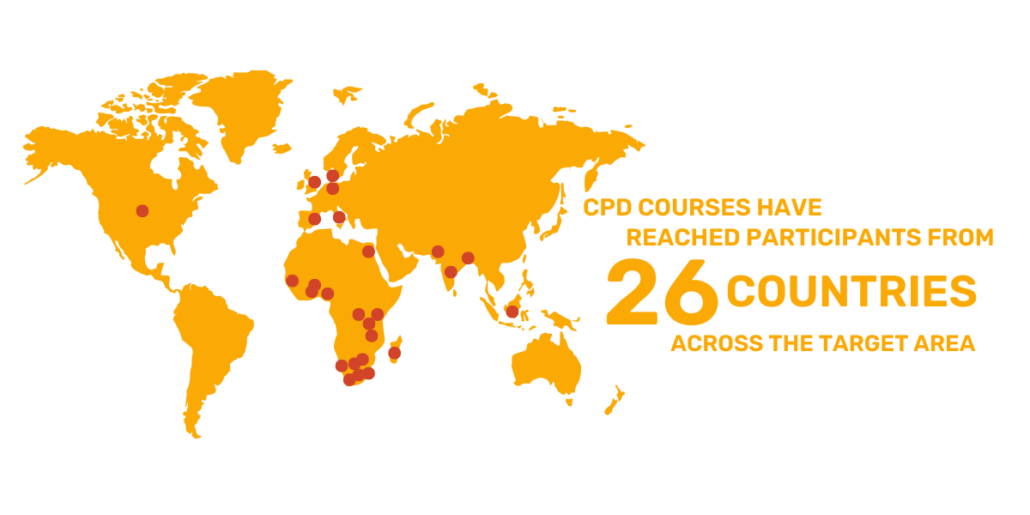
Across the courses, participant feedback has shown a strong and consistent positive learning experience. To date, we have supported the professional development of 517 professionals from 26 different countries.
Future Female Leaders in Energy
Future Female Leaders has seen 328 graduates, a 78% graduate rate, with many women sharing how the course has helped them advance, or even pivot, their careers. Mekides Ashagre shared that, “the course was a turning point, it gave me the tools, the network, and the confidence to show up in rooms where decisions are made.” while Hannah Muthoni Gichuki, on completion of the FFL course took a bold leap and started her own sustainable entrepreneurship journey.
The Future Female Leaders in Energy programme was especially impactful in supporting confidence-building and professional development. “From my perspective, the programme helped participants strengthen not only their technical knowledge, but also their ability to engage professionally within the sector. Over time, there was visible growth in the confidence of participants when presenting their work, participating in activities and engaging with broader energy-related topics.” – Mascha Moorlach
Circular Economy and Sustainable Energy Transition
CESET has seen 3 cohorts and 30 students graduate with feedback showing an appreciation for the practical nature of the course. Participants valued the real-world case studies, applied examples, and opportunities to connect theory with practice.
“The course provided a practical and well-structured understanding of circular economy and sustainable energy transition. The content was highly relevant and enriched by real-world examples and case studies. I particularly appreciated the balance between technical concepts and their practical application. I would strongly recommend this programme to professionals and students seeking to build expertise in climate-resilient and sustainable energy solutions.” – student feedback
“The CESET course was an insightful and well-organised learning experience that provided valuable knowledge and practical skills. The content was relevant, engaging, and delivered by a knowledgeable facilitator. I especially appreciated the real-world applications covered in Lesson 5, which connected directly to my work. I would highly recommend this course to anyone looking to strengthen their understanding and gain practical insights in the field.” – student feedback
Integrated Data Energy Analytics
Six cohorts have completed the IDEA course which has supported 80 graduates. The content was widely seen as relevant to real-world energy and data challenges, particularly in areas such as analytics, AI, renewable energy systems, consumption behaviour, and ethical data use.
Overall, the testimonials reflect a programme that is engaging, interdisciplinary, and practically grounded. Participants consistently emphasised its value in building both technical capability and a stronger understanding of how data-driven approaches can support more informed and responsible decision-making in the energy sector.
“This course gave me a practical framework for thinking through problems I face every day as an energy data analyst in Tanzania. The modules on data ethics, privacy, and algorithmic fairness were especially relevant, and they connected directly to real decisions I make around customer data and smart meter analytics. The structure was clear, the case studies were grounded in real-world issues, and the workload was manageable alongside a full-time job. I would recommend this course to anyone working at the intersection of energy, data, and technology who wants to do their work more responsibly – starting at my workplace in Arusha.” – student feedback
“This programme has been a masterclass in bridging the gap between raw data and high-level strategic decision-making in the renewable energy sector. The modules on end-user consumption behaviour, advanced forecasting techniques, and operational analytics provided the exact toolkit required to translate complex grid data into high-impact business insights. By mastering these analytical proficiencies, I can leverage predictive forecasting to perform sophisticated market due diligence and quantify technical performance to drive financial returns for institutional stakeholders. I highly recommend this course to any energy professional looking to elevate their rigour and evolve from a technical advisor into a strategic leader capable of shaping the future of energy systems.” – student feedback
Integrated Energy Systems
IES has now seen 79 graduates across 9 cohorts. The impact of the course is best reflected in the experiences of those who completed it. Participants highlighted its practical relevance, strong academic foundation, and the confidence it gave them to apply their learning in real-world energy contexts.
“The course provided practical, well-structured insights into energy management, energy efficiency, and renewable energy systems, with concepts that can be readily applied in professional practice. I particularly appreciated the balance between technical content and real-world applications. I would highly recommend this programme to anyone looking to strengthen their knowledge and contribute to sustainable energy solutions.”– student feedback
“This course provided me with an all-round understanding of Integrated energy systems. The content delivery is very detailed and well structured, building fundamental knowledge of energy systems across the world. The research-based exercises provide an opportunity to apply the knowledge gained in energy security, systems thinking, energy markets and energy efficiency in to one’s lived experiences. I am leaving this course with a more-than-average understanding of integrated energy systems and a clear direction for my energy career.” – student feedback
We have been so impressed by the interest shown in our CPD courses – it shows that globally, young energy professionals are committed to upskilling themselves, growing their expertise and contributing towards SDG7. In doing so, CPD plays a vital role in accelerating the transition towards more sustainable, resilient and inclusive energy systems.

