
Tribhuvan University Successfully Concludes 14-Day Training on Detailed Feasibility Studies for Solar PV Systems
The Center for Energy Studies (CES), Institute of Engineering (IOE), Tribhuvan University has successfully completed a 14-day Professional Training on Detailed Feasibility Study (DFS) for Solar PV Systems, held from 17 to 30 November 2025 at the CES Pulchowk campus in Lalitpur.
The programme forms part of a wider effort to strengthen Nepal’s technical capacity in renewable energy planning, feasibility assessment, and project development. Participants included students from the M.Sc. Engineering in Renewable Energy Engineering (MSREE) programme, as well as government officials, faculty members, and professional engineers, creating a diverse learning environment representative of the energy sector in Nepal.
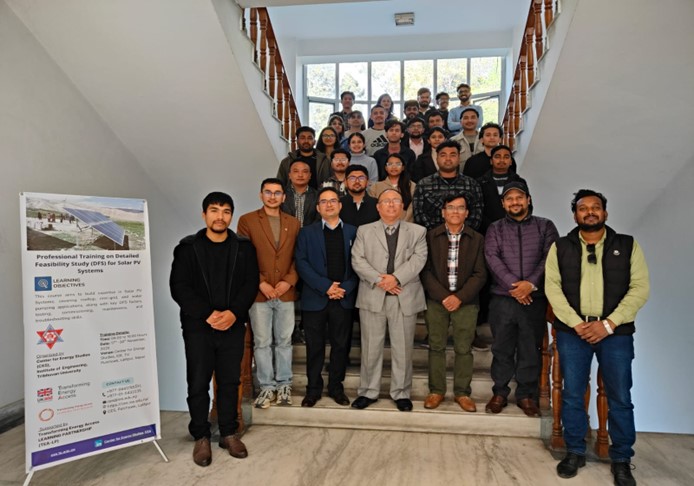
Participants at the DFS workshop hosted by CES, IOE, Tribhuvan University.
Comprehensive Training for Real-World Solar Applications
The course was designed to build practical capacity in three key solar application areas:
-
Solar Mini-Grids (SMG)
-
Solar Rooftop Systems (SRT)
-
Solar Water Pumping (SWP)
Over two weeks, the training combined theory with applied learning, allowing participants to complete field assessments, system design exercises, simulation work, case studies, and full DFS report preparation using recognised industry standards. Key competencies developed during the course included:
-
Evaluation of site conditions and solar resource potential
-
Component sizing and system design
-
Economic and financial analysis
-
Environmental and social risk considerations
-
Understanding of regulatory frameworks and reporting requirements
This practical, application-focused structure ensured that participants left with confidence in designing real renewable energy projects across different use cases and geographic contexts.
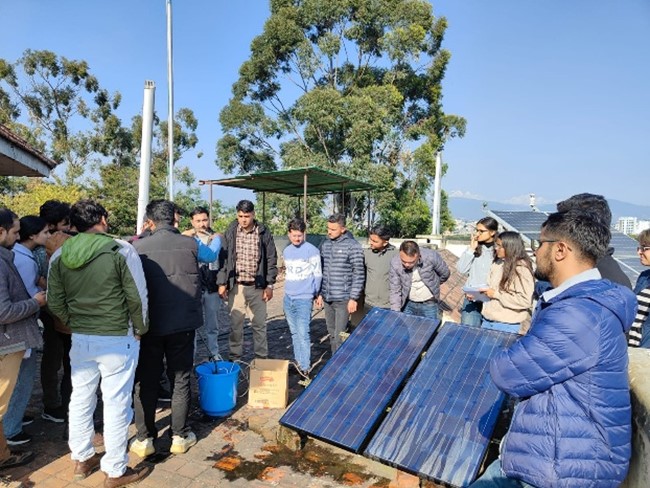
Participants receiving hands-on, practical training during the workshop.
Software Support to Strengthen Technical Learning
To enhance the hands-on learning experience, the Transforming Energy Access Learning Partnership (TEA-LP) provided access to HOMER Pro software license seats. The software enabled participants to model and optimise mini-grid system performance and techno-economic feasibility, helping them develop realistic system configurations aligned with national and international design standards.
Participants also worked with PVsyst and Excel-based analytical models, ensuring familiarity with widely used tools for solar system sizing, simulation, and financial modelling.
Collaborative Delivery and Sector Advancement
The training programme was developed and implemented with support from the GIZ-funded Promotion of Solar Technologies for Economic Development (POSTED) programme and Global Sustainable Energy Solutions (GSES). This collaboration reflects the importance of shared expertise in strengthening Nepal’s clean-energy workforce and advancing access to sustainable technology solutions.
Participants who met minimum criteria—including at least 90% attendance and satisfactory performance in theoretical and practical assessments—were awarded the Certificate of Competence in Detailed Feasibility Study of Solar PV Systems by CES.
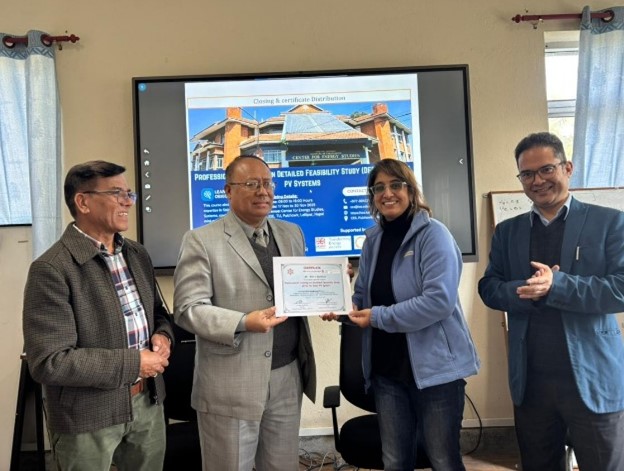
A participant receiving a Certificate of Competence in Detailed Feasibility Study of Solar PV Systems by CES
Supporting Nepal’s Energy Transition
The successful completion of this training marks an important step toward expanding Nepal’s skilled workforce in solar PV planning and project development. By equipping professionals with the ability to conduct high-quality feasibility assessments, Nepal is better positioned to accelerate its clean-energy transition and improve access to reliable, affordable electricity.
Tribhuvan University, CES, IOE, GIZ POSTED, GSES, and TEA-LP are proud to support this impactful effort and look forward to continuing collaboration to strengthen technical capacity and energy education in Nepal and across the region.

