
Advancing women-led innovation in Electric Mobility and Grid Resilience
When graduate of BS Electrical Engineering Roha Rehan from partner university Lahore University of Management Sciences (LUMS), reached out to us about the possibility of attending the Institute of Electrical and Electronics Engineers (IEEE) conferences in Singapore and Wollongong (Australia) where her papers had already been accepted, we were only too happy to support.
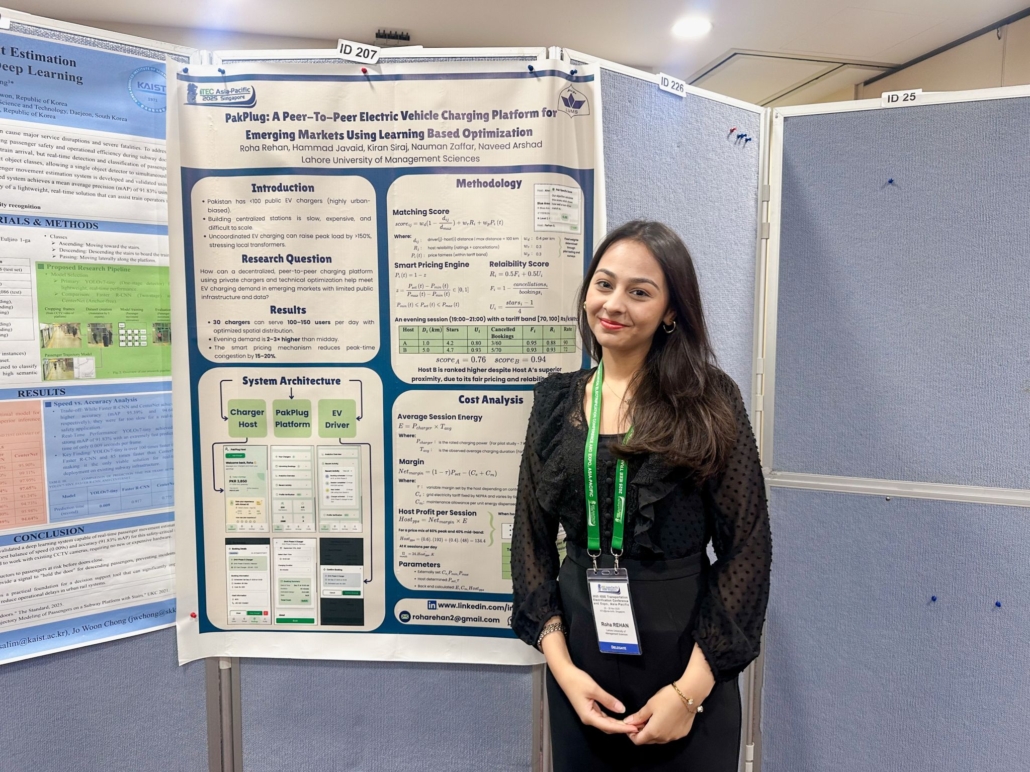
Roha in front of her research poster at the IEEE Transportation Electrification Conference Asia-Pacific 2025. Source: RR
Presenting her research in person at the IEEE Transportation Electrification Conference Asia-Pacific 2025 in Singapore marked a defining moment in Roha Rehan’s academic journey. As the youngest participant and the only undergraduate presenting a published paper, she stood alongside master’s students, PhD researchers, and industry professionals from around the world. As she noted; “Presenting my work to diverse audiences helped me develop strong public-speaking skills and, more importantly, gave me the confidence to believe in my research, articulate its value, and put it out into the world. Engaging with experts, peers, and practitioners pushed me to explain my work more clearly, defend my assumptions, and think critically about its broader implications.” For Roha, the experience was both humbling and affirming: a powerful reminder that the challenges she was studying in Pakistan are part of a global transition toward cleaner, smarter energy and transport systems.
Roha’s path into energy research was not straightforward. As a third-generation electrical engineer, she initially viewed her degree as an expectation rather than a personal ambition. That perspective began to shift in her third year, when a data science course sparked her curiosity and opened an unexpected pathway – one that would ultimately position her at the intersection of electric mobility, renewable energy, and grid stability.
Determined to combine data-driven analysis with her growing interest in electric vehicles (EVs), Roha embarked on a research project exploring how EV adoption in Pakistan could grow by 2030 in line with global climate commitments and Nationally Determined Contributions (NDCs). What began as a forecasting exercise soon evolved into a deeper technical investigation. For her senior year thesis, she examined how large-scale EV uptake would affect Pakistan’s national power grid and whether solar energy integration could offset the additional demand.
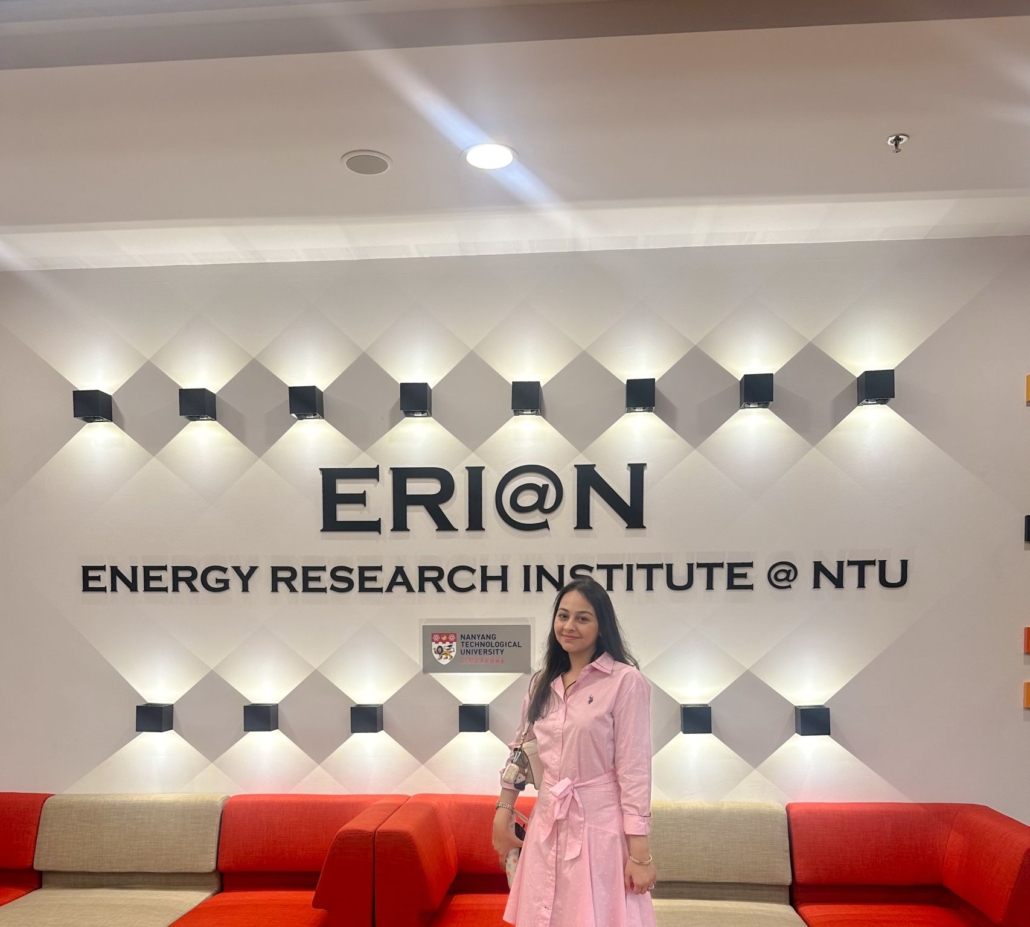
Roha visiting the Energy Research Institute at Nanyang Technical University in Singapore. Source: RR
At the macro level, her projections suggested that the grid could technically handle increased EV loads if supported by sufficient solar capacity. However, a more granular analysis revealed a critical vulnerability. At the transformer level within distribution networks, even modest EV penetration could result in overloading. In Pakistan, transformers are typically replaced only after failure rather than through proactive planning. If each household served by a small transformer were to adopt an EV, existing infrastructure could quickly exceed capacity.
To address this gap, Roha developed a simulation-based tool that models different EV penetration scenarios and evaluates their impact on distribution transformers. The objective was clear: enable proactive, data-informed infrastructure planning rather than reactive crisis management. Her work directly aligns with the ambitions of SDG7 (ensuring access to affordable, reliable, sustainable and modern energy for all) by highlighting the importance of resilient and forward-looking grid systems in emerging economies.
Mentorship has played a central role in shaping her research direction. Roha mentioned both Professor Nauman Zaffar and Dr Kiran Siraj as having supported, encouraged and guided her research. Courses in battery energy storage systems and decentralised energy solutions further strengthened her understanding of how storage, microgrids, and community-scale renewables can support grid stability. These academic experiences collectively sharpened her focus on scalable, context-specific solutions for developing countries.
Beyond the formal sessions at IEEE in Singapore, the experience provided invaluable opportunities for cross-cultural exchange. Conversations with researchers and practitioners from across Asia, Europe, and Africa reinforced a shared reality: while national contexts differ, the need for resilient grids, equitable access, and cost-effective clean energy solutions is universal. Roha also came away with a deeper appreciation for the complexity of technological progress – recognising that every advancement, from underground cabling to advanced battery systems, introduces new engineering challenges that must be thoughtfully managed.
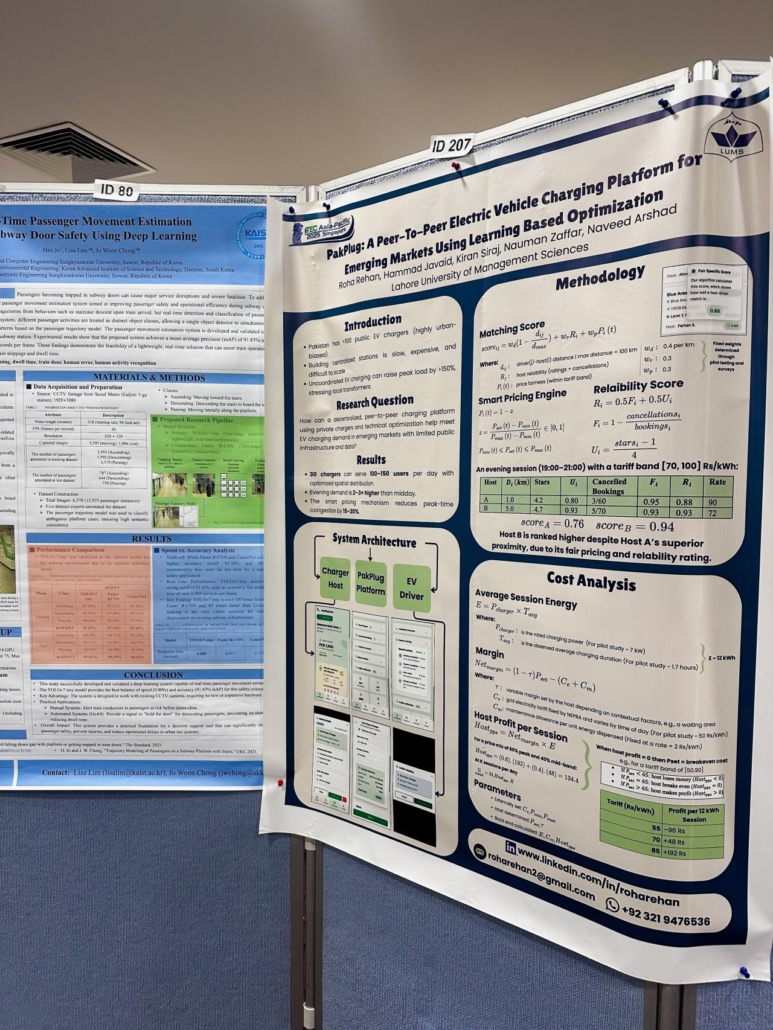
Roha’s presentation poster on her research on PakPlug: A Peer-to Peer Electrical Vehicle Charging Platform for Emerging Markets Using Learning Based Optimisation. Source: RR
Her paper focused on PakPlug, a peer-to-peer EV charging platform designed for low-cost, infrastructure-light deployment. In contexts where EV adoption targets exist but charging infrastructure remains limited, decentralised and community-driven solutions can serve as practical bridges during early transition phases. The conference also offered exposure to advances in EV systems, battery technologies, and integrated transport networks, including a visit to research facilities at Nanyang Technological University’s Energy Research Institute.
Roha also shared her research at the IEEE Energy Transition and Future Grids 2025 in Wollongong virtually. There, she presented work derived directly from her thesis on transformer-level EV load planning, situating Pakistan’s distribution challenges within a broader global conversation about future-ready grids.
Now working as a research assistant at LUMS, Roha has expanded her research to include microgrids and the air-quality benefits of replacing internal combustion engine rickshaws with electric alternatives in urban environments. She plans to pursue a master’s degree in sustainable energy and, in the long term, hopes to establish a climate-tech or energy research lab focused on developing countries in South Asia.
Her journey reflects the power of student access, mentorship, and international knowledge exchange in driving progress toward SDG7. By focusing on distribution-level planning, decentralised charging solutions, and community-scale renewables, Rohan Rehan is contributing to an energy transition that is not only technologically advanced, but also equitable and resilient.
Through supporting emerging researchers like her, TEA-LP continues to strengthen a global learning partnership committed to advancing women in energy and accelerating sustainable energy access for all. We look forward to following Roha’s career! You can connect with her through her LinkedIn profile or email at roharehan2@gmail.com

